MyInvestor vs Trade Republic 2026: taxes, funds and fees compared
//11 min read
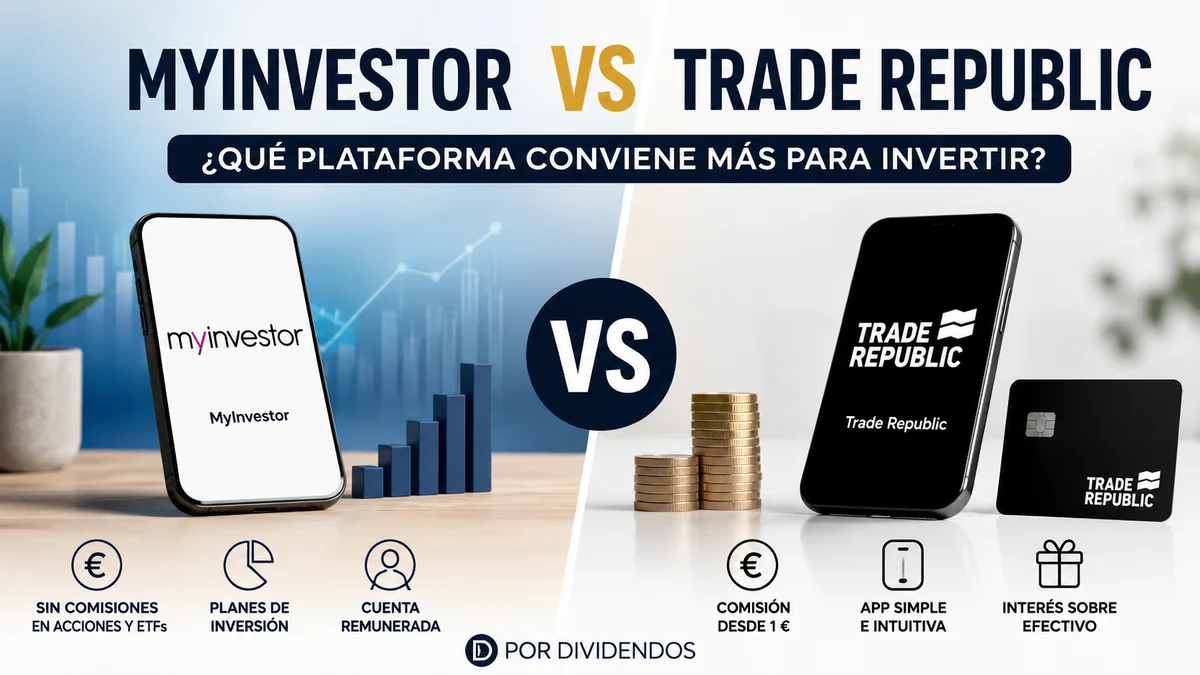
MyInvestor and Trade Republic compete for the same monthly contribution, but from opposite structures: one is a Spanish bank with EUR 100,000 guarantees and index funds with no add-on fees; the other is a German broker built around automation and fractional shares. The real decision is not about commissions, it is about taxes and vehicle: funds or ETFs?
If you are weighing this comparison, you probably already know both are cheap. The difference lies in three questions the fee table does not answer: how much tax paperwork you are willing to take on, whether your vehicle is index funds or ETFs, and whether you need fractions so your monthly contribution goes in whole.
This comparison puts MyInvestor vs Trade Republic side by side from that angle, with the full reviews behind it: MyInvestor and Trade Republic.
This is not financial or tax advice. Fees, promotions and rates change often. Verify current conditions and your own tax situation before deciding.
Quick verdict
Main need
Better fit
Why
Indexing through funds (not ETFs)
MyInvestor
Clean share classes with no added fee and tax-free fund switches
Zero tax paperwork
MyInvestor
Holds assets in Spain: no Modelo 720 and a pre-filled tax return
Small contributions to stocks or ETFs
Trade Republic
Fractions and investment plans; MyInvestor has a EUR 3 minimum per stock order
Double withholding at MyInvestor; your own paperwork at Trade Republic
Interest on cash
Tie
Interest-bearing account (MyInvestor) vs interest on cash (Trade Republic)
Short version: MyInvestor wins if your vehicle is index funds or if Spanish tax convenience matters most; Trade Republic wins if you contribute small amounts to ETFs and stocks and want real automation with fractions.
Comparison table
Criterion
MyInvestor
Trade Republic
Structure
Spanish bank (Andbank group), Bank of Spain + CNMV
Double withholding (source + Spain), ~30% on US REITs
Withholding at source; filing is on you
The difference that decides it: where your portfolio is held
This is the real axis of the comparison, and it appears in no fee table.
MyInvestor holds your assets in Spain. Practical consequences: the reporting obligations for assets held abroad (Modelo 720, D-6) do not apply, your activity reaches the pre-filled Spanish tax return already reflected, and the guarantees are the Spanish ones — FGD for cash and FOGAIN for securities, EUR 100,000 each.
Trade Republic is a German broker with a Spanish branch. Declaring dividends, sales and interest is your responsibility, and on Modelo 720 there is no universal rule: it depends on the account and custody structure applicable to your case, so review the annual tax documentation and, if you exceed thresholds, ask an adviser.
In short: MyInvestor saves you a weekend of paperwork a year and gives you double the guarantee cover. If that is your main criterion, the comparison ends here.
But there is a counterpart almost nobody mentions, and it runs the other way: double withholding. A US dividend received at MyInvestor takes the 15% withholding tax at source plus the Spanish withholding on arrival; the excess is recovered through double taxation relief months later, when you file. And in my experience with US REITs the withholding rises to ~30% even with the W-8BEN processed. Administrative convenience yes, cash efficiency no.
Index funds vs ETFs: not the same thing
There is no possible tie here, because they do not compete on the same product.
MyInvestor gives access to index funds in clean share classes (Vanguard, iShares, Fidelity and more) with no custody fee, no subscription fee and switches between funds at no cost and with no tax impact. That last point is the structural advantage of the Spanish fund over the ETF: switching funds does not realise capital gains, so you defer taxation while you rebalance.
Trade Republic does not offer traditional mutual funds: its universe is stocks, ETFs, crypto, bonds and derivatives. With ETFs, every sale to rebalance is a taxable event.
If your strategy is "contribute to two or three index funds and rebalance yearly", MyInvestor is objectively the better vehicle. If your strategy is distributing ETFs to build income, or individual dividend stocks, the index fund does not serve you and this advantage does not apply.
Real cost of a monthly contribution
This is where MyInvestor loses on small amounts.
MyInvestor: 0.12% with a EUR 3 minimum per stock order (EUR 1 on ETFs, EUR 0 with the Premium plan). A EUR 300 stock purchase pays EUR 3, an effective 1%. The EUR 25 cap protects large purchases well.
Trade Republic: EUR 1 external cost per individual transaction, and investment plans with no execution commission. That same EUR 300 contribution costs EUR 1 (0.33%) — or the applicable external cost inside a plan.
And there is the detail that weighs most over time: MyInvestor has no fractional shares. If you contribute EUR 200 and the share trades at EUR 170, you buy one and leave EUR 30 uninvested. Trade Republic invests the full amount. For small recurring contributions, that gap compounds more than the commission does.
An important nuance: with index funds MyInvestor does not have this problem — you contribute exact amounts from very low sums with no added fee. The EUR 3 minimum is a limitation of its stock brokerage, not of its funds side.
Currency and international dividends
MyInvestor charges 0.30% for currency conversion (0.25% with Premium) when buying, selling and also when receiving dividends in a foreign currency. Its answer to that is the Premium plan (EUR 7.99/month), which adds a dollar account: you hold a USD balance, invest and receive dividends without converting. With a few thousand euros in cash and frequent dollar payments, the plan pays for itself; with a small euro-only account, it does not.
Trade Republic offers a euro experience with no explicit conversion fee, with spreads and product costs embedded depending on the asset and execution venue.
For an international income portfolio, neither is the specialist: the reference there remains Interactive Brokers for currency cost and reporting depth, as covered in our three-way comparison. Review the dividend tax hub before deciding if your portfolio is global.
Automation: two different philosophies
Both automate, but not the same thing:
Trade Republic automates per asset: you pick the ETF or stock, amount and frequency, and the plan buys with fractions. You keep control of the composition.
MyInvestor automates the whole portfolio with its managed portfolios (robo-advisor, ~0.15% management fee plus the cost of the underlying funds): answer the questionnaire and the platform picks the funds, invests contributions and rebalances by itself. It also offers indexed pension plans, a product Trade Republic does not cover.
If you want to decide what you buy each month, Trade Republic. If you want to delegate composition and rebalancing, MyInvestor. And if you can pick two or three index funds and rebalance once a year, do it yourself and save the 0.15%.
Which to pick for your profile
Pick MyInvestor if: your vehicle is index funds, you want Spanish EUR 100,000 guarantees, you want nothing to do with Modelo 720, you are interested in an indexed pension plan, or you prefer a managed portfolio that rebalances itself.
Pick Trade Republic if: you contribute small or medium amounts to ETFs and stocks, you need fractions to invest the full amount, you want per-asset investment plans and you do not mind handling your own tax return.
Use both if your portfolio has two legs, which is the most common split among our readers: index funds and Spanish stocks at MyInvestor (tax convenience, switches with no toll) and an automatic ETF or stock plan at Trade Republic (fractions, low cost per contribution).
Compare with others if the bulk of your portfolio is international dividends: MyInvestor's double withholding and Trade Republic's paperwork make a global specialist worth it. The full breakdown is in our broker comparison.
Frequently asked questions about MyInvestor vs Trade Republic
Which is cheaper for investing every month?
For small contributions to stocks or ETFs, Trade Republic: EUR 1 external cost per trade against MyInvestor's EUR 3 minimum on stocks (EUR 1 on ETFs). For index funds, MyInvestor adds no fee at all, so it is unbeatable there: you only pay the fund's TER.
Which has less tax paperwork?
MyInvestor. Because it holds assets in Spain, neither Modelo 720 nor D-6 applies, and your activity appears in the pre-filled tax return. With Trade Republic you declare dividends and sales yourself, and Modelo 720 depends on your specific case.
Can I buy index funds at Trade Republic?
No. Trade Republic offers stocks, ETFs, crypto, bonds and derivatives, but not traditional mutual funds. If you want clean share classes and tax-free switches, of these two only MyInvestor covers that product.
Does MyInvestor allow fractional shares?
No. You buy whole units, so the part of your contribution that does not reach one share stays as cash. Trade Republic does allow fractions through its investment plans. With MyInvestor's index funds the problem does not exist: you contribute exact amounts.
How are dividends taxed at each one?
At MyInvestor, a foreign dividend takes the withholding at source plus the Spanish withholding on arrival, and the excess is recovered when you file (with US REITs the withholding at source rises in practice to ~30%). At Trade Republic the foreign dividend arrives with its withholding at source and you declare the payment. In both cases, the full guide is in dividend taxation.
Is MyInvestor's Premium plan worth it?
It depends on two things: how much cash you keep and whether you receive dividends in dollars. It is around EUR 96 a year that buys a better rate on the account, a USD account with no currency conversion, ETFs with no per-order minimum and FX at 0.25%. With an international portfolio and a cash buffer it is justified; with a small euro account, the free plan is enough.
Which has better protection if the broker fails?
MyInvestor, by structure: it is a Spanish bank with FGD up to EUR 100,000 for cash and FOGAIN up to EUR 100,000 for securities. Trade Republic operates under the German scheme. No guarantee covers market losses, only the intermediary's insolvency.
Can I transfer my funds from another bank to MyInvestor?
Yes, and it is the most common move: fund transfers between Spanish institutions carry no cost and no tax impact. ETFs and stocks do not enjoy that regime: there, changing broker means a securities transfer or selling and rebuying.
The honest way to close this comparison: they compete less than they appear to. MyInvestor is the home base of Spanish passive investing — funds, guarantees, zero paperwork — and Trade Republic is the best machine for contributing small amounts often to ETFs and stocks. If your strategy is index funds, the answer is MyInvestor. If it is small automated contributions, Trade Republic. And if it is both, holding both accounts is not indecision: it is the right split.
This article is educational content, not financial or tax advice. Fees, plans and rates can change: always verify current conditions on each institution's official website.