Interactive Brokers Spain review 2026: fees, taxes and pros and cons
//19 min read
Interactive Brokers remains one of the most complete brokers available to investors in Spain, especially if you want stocks, ETFs, dividends, currency control, detailed reports and global market access in one account. It is not the easiest broker for a first-time investor, but it can be one of the strongest long-term options once you understand its fees and reporting.
Interactive Brokers, usually known as IBKR, is a global broker with a much longer track record than most investing apps that have become popular in Europe. Its proposition is not to be the prettiest app or the most beginner-friendly interface. The real value is market access, professional tools, competitive pricing and detailed reporting.
For a Spanish tax resident, the right question is not simply whether Interactive Brokers is a good broker. The better question is whether it fits the way you invest. Buying 100 euros per month in one ETF is not the same as building an international dividend portfolio, operating in dollars, using margin, selling covered calls or preparing data for Spanish IRPF, Form 720 and currency tracking.
This review looks at Interactive Brokers from that practical angle: real fees, strengths, limits, safety, Spanish tax considerations, comparison with Trade Republic, DEGIRO, XTB and HeyTrade, and my own view after using it as my main broker since 2019. This is not financial or tax advice; it is a practical comparison before opening an account.
Quick verdict: who Interactive Brokers is for
Interactive Brokers works particularly well if you want to build a serious long-term portfolio and you are willing to spend some time learning the platform. It is built for investors who value control: market selection, order types, currencies, pricing plans, account reports and security settings.
It is also strong for international dividend portfolios. If you buy US, UK, European, Canadian or other foreign stocks, IBKR offers broad access, efficient currency handling, W-8BEN documentation for US securities and detailed activity reports. For an investor who reinvests dividends and tracks performance by currency, those details matter.
Where IBKR is weaker is simplicity. If all you want is to open an app, create a monthly ETF savings plan and forget about the details, Trade Republic or XTB may feel easier. Interactive Brokers gives you more control, but that control comes with menus, permissions, different platforms and a real learning curve.
My summary:
Investor profile
Fit with IBKR
Reason
Global stock and ETF portfolio
High
International access, currency control and detailed reports
Dividend investor
High
W-8BEN, reporting, multiple markets and withholding tax control
Simple ETF dollar-cost averaging
Medium
Works, but smaller plans can be easier elsewhere
Active or advanced trader
High
TWS, advanced orders, margin, options and APIs
Absolute beginner
Medium-low
The platform can feel overwhelming at first
User focused on simple automation
Medium
Fractional shares exist, but it is not as smooth as a savings-plan app
Investor focused on tax data
High
Reporting is one of its main strengths
What is Interactive Brokers?
Interactive Brokers is an international broker offering access to stocks, ETFs, options, futures, bonds, currencies, funds and other instruments from one account. The group is listed on Nasdaq under the IBKR ticker and publishes financial information as a public company, which adds a layer of transparency compared with many younger private brokers.
For European residents, the relevant entity is often Interactive Brokers Ireland Limited, regulated by the Central Bank of Ireland. That does not make the account a Spanish bank account and does not automatically remove Spanish reporting obligations, but it places the contractual relationship within a European regulatory framework.
IBKR can be summarized in four ideas:
Access to many markets from one account.
Competitive fees, although less simple than most neobrokers.
Platforms for different experience levels.
Detailed reporting for analysing and declaring a portfolio.
That combination makes it attractive once you move beyond "I want to buy my first ETF" and start needing more control: currencies, withholding taxes, dividends, corporate actions, transfers, foreign stocks, limit orders or annual reports.
Interactive Brokers fees in 2026
The most important thing about IBKR pricing is that there is no single fee for everything. In IBKR Pro, you can choose between fixed pricing and tiered pricing. Fixed pricing is easier to understand. Tiered pricing can be cheaper in many trades, but it may include market, regulatory or clearing fees depending on the case.
For US stocks and ETFs, IBKR Pro tiered pricing starts at 0.0035 USD per share for the first volume tier, with a 0.35 USD minimum per order. Fixed pricing is shown as 0.005 USD per share, with a 1 USD minimum. IBKR Lite exists for eligible US residents, but it is not the usual framework for a Spanish resident investor.
For European stocks and ETFs, IBKR publishes commissions as a percentage of trade value. In many European markets, the initial IBKR Pro tier is around 0.05% of trade value, with minimums that depend on market, product and routing. In practice, this means that very small orders may be less efficient than a free savings-plan app, while medium or larger purchases can be very competitive.
The main costs to separate are:
Cost
What to check
Trading commission
Depends on market, currency and fixed vs tiered pricing
Third-party costs
May appear under tiered pricing depending on market
FX conversion
One of IBKR's strongest points compared with brokers using high mark-ups
Market data
Real-time quotes may require subscriptions or snapshots
Margin
Competitive, but risky and not suitable without experience
Inactivity
The old monthly inactivity fee is no longer the major issue it used to be for standard individual accounts
My view: Interactive Brokers is not always the cheapest broker for investing 50 or 100 euros per month in one European ETF. If your plan is a small automated contribution, a savings-plan app may be more ergonomic. For larger portfolios, international stocks, dividends in multiple currencies and regular activity, IBKR often wins on total control and long-term cost.
Fixed vs tiered pricing: which should you choose?
For most buy-and-hold investors in Spain, tiered pricing is the first structure I would review. It can reduce the cost of many trades, especially for US stocks or when external execution costs are not significant. The trade-off is that the activity statement may be harder to read because costs are split across several concepts.
Fixed pricing has one obvious advantage: simplicity. It is easier to know what to expect and avoid surprises in markets where you do not want to analyse each execution cost. If you are starting with IBKR and feel lost with routing, exchanges and third-party fees, fixed pricing may be a reasonable initial choice.
The practical decision:
Situation
Reasonable option
Frequent US stock purchases
Review tiered pricing
Occasional European purchases
Compare fixed and tiered before trading
Very small order sizes
Watch minimum order fees
You want maximum simplicity
Fixed may be more comfortable
You want to optimize costs
Tiered, with activity statement review
I would not switch pricing structure constantly or spend too much energy saving cents if that makes you trade worse. The key is that your costs do not undermine the strategy. For long-term investing, discipline, avoiding mistakes and keeping clean documentation usually matter more than saving a few cents on one order.
Safety and regulation
Safety is one of the strongest arguments for Interactive Brokers. Not because it removes market risk, which never disappears, but because it is a listed group with a long track record, multiple regulators and infrastructure that feels more institutional than many newer investing apps.
For European clients of Interactive Brokers Ireland, the company states that certain clients are protected by the Irish Investor Compensation Scheme. This does not cover market losses or bad investment decisions. Its role is limited to certain insolvency or firm-failure situations, subject to specific conditions and limits.
IBKR also offers useful account security tools:
Two-factor authentication through IB Key.
Mobile app confirmations.
Activity alerts and restrictions.
Login and movement reports.
Trading permissions by product and market.
One thing I like is that Interactive Brokers does not grant every trading permission by default. If you want options, margin, futures or complex products, you need to request permissions and answer suitability questions. This may feel annoying, but it reduces the chance of a beginner enabling products they do not understand.
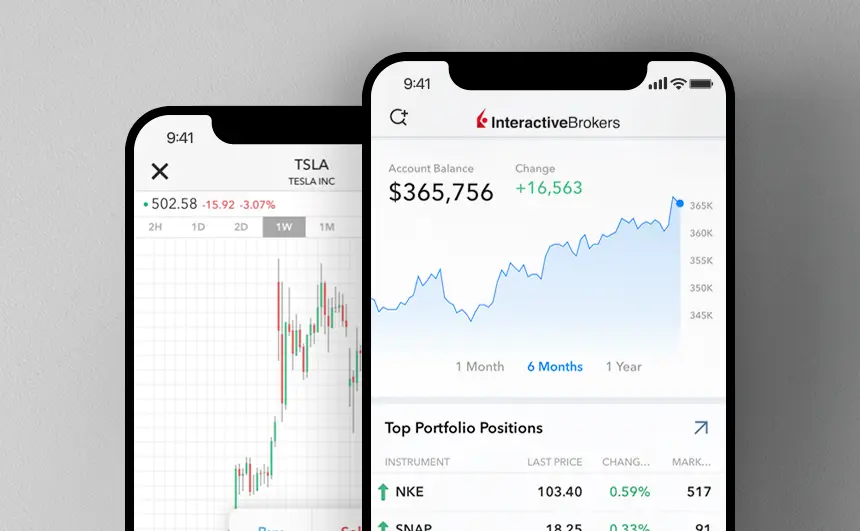
Platforms: Client Portal, IBKR Mobile, Desktop and TWS
Interactive Brokers has improved the user experience for non-professional investors. Years ago, the feeling was that everything revolved around Trader Workstation, a powerful but intimidating platform for someone who only wanted to buy stocks and ETFs. Today you can use Client Portal in a browser, IBKR Mobile, IBKR Desktop and TWS.
Client Portal is enough for many tasks: reviewing the portfolio, buying, selling, converting currency, downloading reports and managing the account. IBKR Mobile works well for monitoring and simple trading. IBKR Desktop aims to sit between the simplicity of the portal and the power of TWS.
Trader Workstation remains the advanced tool. It is useful for active trading, options, spreads, option chains, conditional orders or multi-window workflows. For a dividend portfolio, you do not need to live inside TWS. Use it only when you need advanced functions.
A sensible starting path:
Open and configure the account through Client Portal.
Activate security and only the permissions you need.
Make the first purchases with simple limit orders.
Download and review Activity Statements from the beginning.
Leave TWS for later if you actually need it.
Interactive Brokers for dividends
For a dividend strategy, IBKR has several strengths. The first is international access. You can buy companies across many markets, not only the most popular stocks or ETFs from a limited list. The second is currency control. If you receive dividends in USD, GBP or CHF, you can decide when to convert, keep the balance in that currency or reinvest directly.
The third point is W-8BEN. For US stocks, this form is important for treaty withholding tax treatment when applicable. IBKR collects tax documentation from non-US clients during onboarding or profile updates.
Reporting is also important. A dividend portfolio generates many small payments, withholding taxes, FX movements and corporate actions. If you use several brokers, tax preparation gets complicated quickly. IBKR does not prepare your Spanish tax return, but it gives you enough data to work properly.
What I would review:
Topic
Why it matters
Withholding tax at source
Determines how much net dividend arrives
Spanish taxation
A foreign broker normally does not behave like a Spanish broker for domestic withholding
Dividend currency
Affects returns and conversion for Spanish tax reporting
Activity Statement, Dividend Report and custom statements
My opinion: for international dividend portfolios, IBKR is one of the most complete brokers. It does not hold your hand as much as a simple app, but if your portfolio is meaningful or you want clean data, I prefer that depth.
Spanish tax: IRPF, Form 720 and D-6
Interactive Brokers does not remove your Spanish tax obligations. If you invest through a foreign broker, you need to track dividends, sales, FX, withholding taxes and possible information returns. This should not scare you, but it does require order.
For Spanish IRPF, dividends are generally taxed in the savings tax base. If foreign withholding tax has been applied, the international double taxation deduction may be relevant within its limits. For US stocks, W-8BEN helps apply treaty treatment when applicable, but that does not mean there is nothing to declare in Spain.
Form 720 is an information return for certain assets and rights located abroad. It is not triggered by receiving dividends alone. It depends on asset categories, thresholds and conditions set by the rules. With an Interactive Brokers account, you should review whether your foreign securities or cash fall within its scope.
The old D-6 filing has been confused for years with any foreign portfolio. Rules changed and the Ministry reduced the obligation for most small investors, linking it to more specific cases such as significant stakes. Even so, it is not a topic to ignore without checking the current model and your own situation.
The practical recommendation is simple: download annual reports, keep evidence, do not mix accounts without tracking, and speak with a tax adviser if your portfolio exceeds relevant thresholds, uses margin, trades derivatives or holds multiple currencies.
Comparison: IBKR vs Trade Republic, DEGIRO, XTB and HeyTrade
Interactive Brokers does not compete in exactly the same category as Trade Republic or XTB. IBKR is a global platform. Trade Republic is a very simple app with savings plans. XTB combines a simple investing experience, stocks and ETFs with no commission up to certain monthly volumes, and a platform also oriented toward CFDs. DEGIRO is a low-cost European broker. HeyTrade is a Spanish alternative with simple pricing and local regulation through Beka.
Broker
Best for
Strength
Main limit
Interactive Brokers
Global portfolios and international dividends
Markets, FX, reporting, tools
Learning curve
Trade Republic
Small plans and automation
Simple app and savings plans
Less advanced control
DEGIRO
Low-cost European investing
Competitive fees and known European brand
Tax/reporting requires attention
XTB
Simple stocks and ETFs
No commission up to 100,000 EUR monthly volume according to its current tariff
FX cost and mixed focus with CFDs
HeyTrade
Spanish residents wanting simplicity
Clear fees, CNMV link through Beka, no dividend fee
Less international depth than IBKR
If I had to simplify:
For small automated contributions: Trade Republic or XTB may be easier.
For a serious global portfolio: Interactive Brokers wins on depth.
For someone wanting a Spanish broker experience: HeyTrade is worth comparing.
For low-cost European access: DEGIRO remains an alternative, but check current fees and reports.
In my case, Interactive Brokers works better as a main broker because I prefer control, reports and broad market access. That does not make it perfect for everyone. If someone only wants to automate 100 euros per month into one ETF, they probably do not need all of IBKR from day one.
Advantages of Interactive Brokers
These are the advantages that matter most to me:
Very broad access to markets and products.
Competitive fees once you understand the structure.
Strong currency conversion compared with many simplified brokers.
Detailed reports for dividends, gains, interest and currencies.
Group safety, scale and track record.
Multiple platforms: mobile, web, Desktop and TWS.
Fractional shares for eligible stocks and ETFs.
Tools for advanced portfolios, options, bonds and margin.
Good fit for investors whose needs grow over time.
The biggest advantage is not one specific commission. It is that IBKR does not become too small quickly. You can start with stocks and ETFs, and years later still use the same account for a much more sophisticated portfolio.
Disadvantages and limits
Interactive Brokers also has clear drawbacks:
The learning curve is real.
The fee structure can be confusing.
It is not the smoothest app for simple recurring plans.
Some real-time market data requires subscriptions or snapshots.
Support may feel less close than with a local broker.
Reports are powerful, but you need to know what to download.
It does not replace proper Spanish tax management.
The common mistake is opening IBKR, seeing too many menus and concluding that it is bad. It is not bad; it is more professional. But if you do not need that depth, complexity becomes a cost. A good broker is not the one with the most features, but the one that fits your strategy and does not push you into mistakes.
My experience using Interactive Brokers since 2019
My experience with Interactive Brokers has been very positive. I have used it as my main broker since 2019, and I keep my most important portfolios there: one focused on ETFs and dividends, and another with a more growth-oriented profile.
What I value most is control. I can work with several currencies, review detailed reports, access different markets and avoid depending on an app that simplifies the experience so much that it hides important data. For a small portfolio, that may feel excessive. For a portfolio that grows over years, it becomes useful.
I have also experienced the less friendly side: menus that are not intuitive, reports with too many options, permissions that need to be activated, interface changes and some initial friction. My advice is not to learn everything at once. Start with the essentials: security, deposits, limit orders, currency conversion, annual reports and dividends.
How I would use IBKR for a dividend portfolio
If I were starting today with Interactive Brokers for dividends, I would do the following:
Open a cash account, not a margin account, unless I had a clear reason.
Activate only the permissions for the stocks and ETFs I actually need.
Complete tax documentation correctly, including W-8BEN where applicable.
Start with simple limit orders.
Avoid order sizes where the minimum commission weighs too much.
Keep an external record of purchases, dividends and currencies.
Download quarterly and annual reports.
Review Form 720 if the portfolio grows and crosses thresholds.
Avoid margin and options until I fully understand the risks.
This reduces errors and makes IBKR work in your favour. The platform can do a lot, but you do not need to use everything.
Interactive Brokers FAQ
Is Interactive Brokers safe for investors in Spain?
It is a global, listed and regulated broker through different entities. For European clients, Interactive Brokers Ireland is regulated by the Central Bank of Ireland and certain clients are covered by the Irish Investor Compensation Scheme. This does not cover market losses.
Does Interactive Brokers report to the Spanish Tax Agency?
You should not assume it works like a Spanish broker. As a Spanish tax resident, you are responsible for declaring dividends, sales, withholding taxes, currencies and information returns when applicable.
Do I need to file Form 720 because I use IBKR?
Not automatically because you use IBKR. You need to check whether your foreign assets and rights exceed the thresholds and conditions of Form 720. The obligation depends on your situation, not only on the broker name.
Does IBKR withhold tax on dividends?
There may be withholding tax at source depending on the country paying the dividend. For US stocks, W-8BEN is relevant for treaty treatment when applicable. You then need to review Spanish tax treatment in IRPF.
Is IBKR better than Trade Republic?
It depends. IBKR is better for control, markets, reports and advanced portfolios. Trade Republic is easier for small plans, automation and a simple user experience.
Is IBKR suitable for beginners?
Yes, but it is not the easiest option. A disciplined beginner can use it well by starting with the basics. A user wanting maximum simplicity may feel more comfortable elsewhere.
Which IBKR platform should I use?
For most investors, Client Portal and IBKR Mobile are enough at first. TWS makes sense when you need advanced trading, options or deeper analysis.
Can I buy fractional shares with Interactive Brokers?
IBKR offers fractional shares for eligible stocks and ETFs, but availability depends on product, market, permissions and entity. Check availability before building a strategy around fractional investing.
Conclusion: my opinion on Interactive Brokers
Interactive Brokers is not the easiest broker, but it is one of the most complete. For a dividend investor, a global portfolio or anyone who wants to take long-term investing seriously, I think it is one of the strongest options available from Spain.
I would not recommend it as the single answer for everyone. If you are starting with small amounts and want simple automation, Trade Republic, XTB or HeyTrade may feel easier. But if your priority is building an international portfolio with strong reports, currency control, safety and room to grow, IBKR is difficult to beat.
My practical recommendation: open the account only if you are willing to spend a few hours understanding it. Configure security, review fees, download reports and start with simple trades. If you do that, Interactive Brokers can support your portfolio for many years without becoming too limited.
Note: Interactive Brokers may change fees, terms, promotions and product availability by country. Always review official documentation before opening an account or placing a trade.