Long-term dividend investing: a step-by-step guide
//12 min read
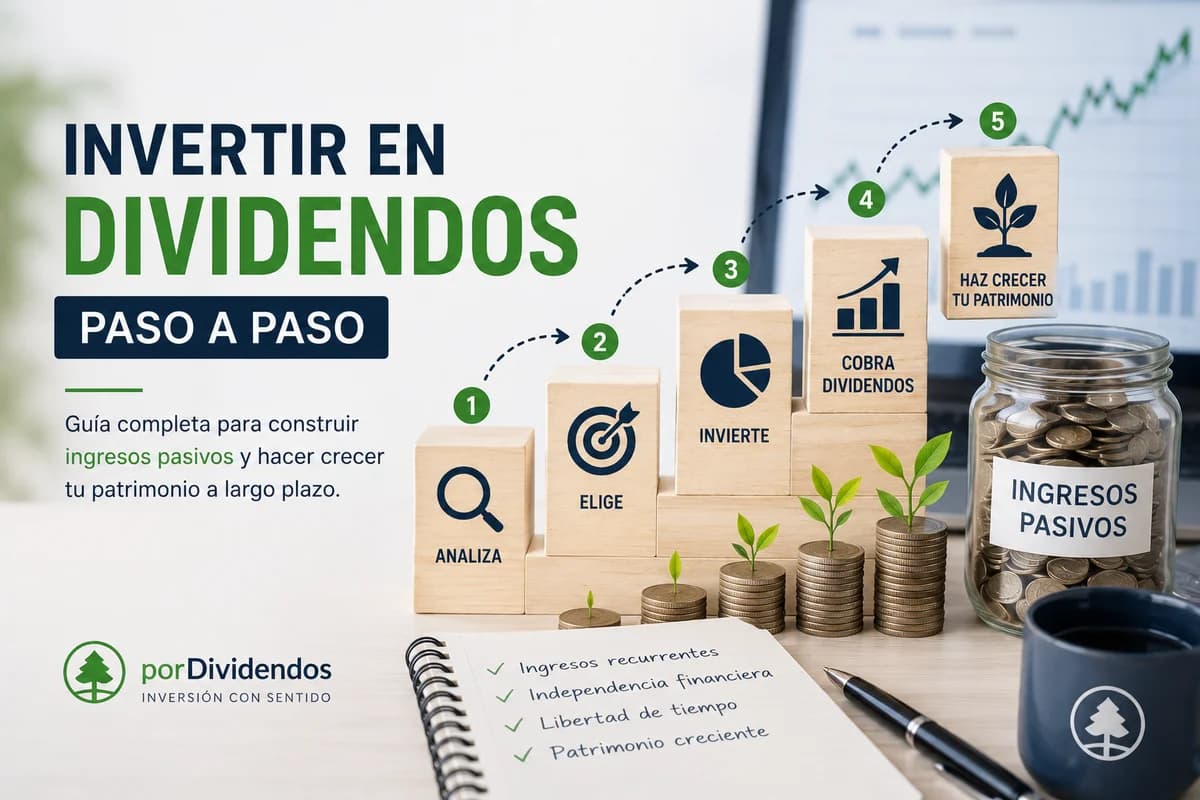
Long-term dividend investing means building a diversified portfolio of quality companies and ETFs that pay out profits, reinvesting those payments while you accumulate, and watching costs and taxes. This guide takes you step by step: define your goal, choose a broker, build the portfolio, reinvest and report correctly.
Dividend investing (often called dividend growth investing) aims to generate a growing income from the profits companies distribute. Instead of relying only on share prices rising, you collect recurring payments that you can reinvest to speed up growth or use as income once you reach financial independence.
It is a strategy especially popular with long-term thinkers: it favours stable companies with a track record of sustainable, growing payouts, and benefits from compounding over decades. This guide brings together everything you need to start from Spain, with links to the tools and resources for each step.
What dividend investing is
A dividend is the part of a company's profit distributed to shareholders. If you own shares in a dividend-paying company, you receive a recurring payment (usually quarterly or annual) for each share you hold. Review the concept in detail in what dividends are.
The most quoted metric is the dividend yield (annual dividend divided by share price), but on its own it says little: a very high yield can signal risk. Just as important are the of the dividend (that profit backs it) and its (that it rises year after year).
sustainability
growth
Glossary: key metrics for dividend investors
Before analysing companies, it helps to master the basic vocabulary. These are the terms you will run into most:
Dividend yield: the annual dividend per share divided by the current share price, expressed as a percentage. It tells you how much you pay today to receive that dividend flow, but on its own says nothing about the quality of the company.
Yield on cost: the dividend yield calculated on the price you actually paid, not on the current price. If a company raises its dividend year after year, your yield on cost grows over time even if the market yield stays stable.
<a href="/en/wiki/payout-ratio" title="The share of earnings a company pays out as dividends. It helps investors judge whether a dividend is sustainable." class="wiki-autolink">Payout ratio: the share of profit a company distributes as a dividend. A very high payout leaves little room to maintain the payment in bad years or to reinvest in the business.
Ex-dividend date: the date from which a buyer of the share is no longer entitled to the next dividend. To collect a payment you must be a shareholder before that date.
Dividend aristocrat: a company that has increased its dividend without interruption for many consecutive years. It is a sign of discipline and stability, though it does not guarantee future behaviour.
DRIP (automatic dividend reinvestment): a mechanism by which the dividends you receive are automatically reinvested in more shares of the same company or fund, feeding compounding without you having to act.
Step 1: define your goal and horizon
Before buying anything, be clear about why you are investing:
Accumulation: you are far from financial independence and reinvest every dividend to grow faster.
Income: you are near or have reached living off your portfolio and start using dividends as income.
Your time horizon defines how much risk you can take and how much dividend growth matters versus starting yield. To estimate how much capital you need, use the how much to live off dividends in Spain guide and the FIRE calculator.
Step 2: choose the right broker
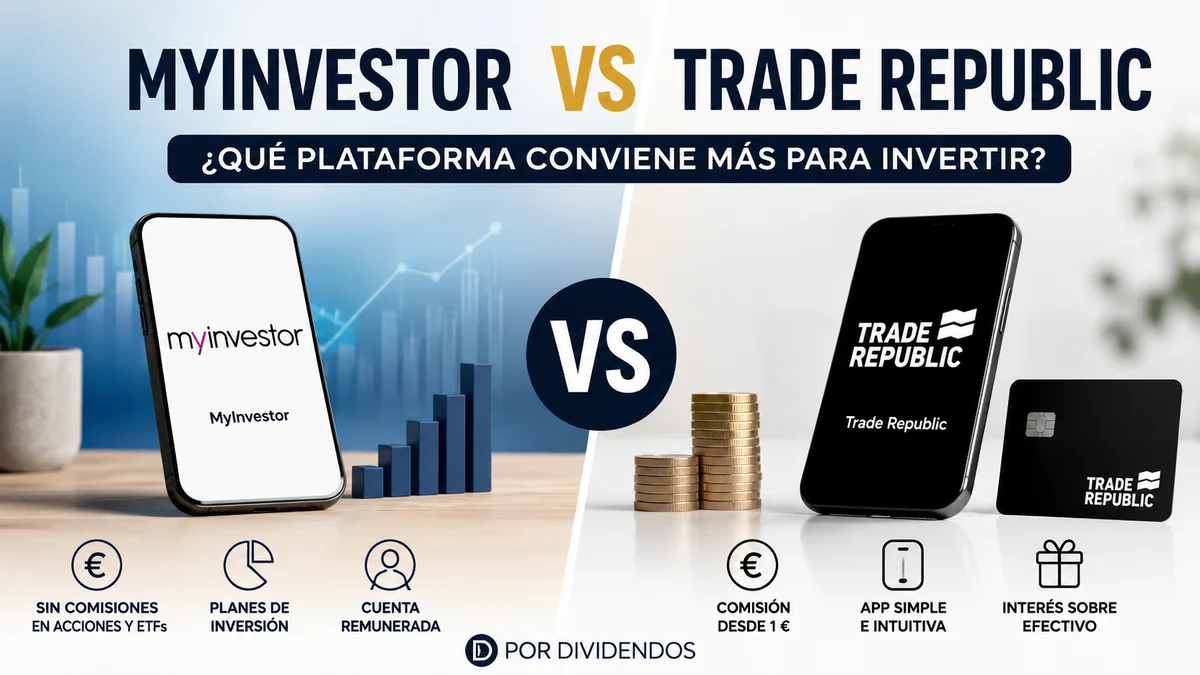
The broker determines your real costs and how easy reporting is. For a dividend portfolio, what matters most is:
Purchase fees, especially if you make small, frequent contributions.
FX cost, paid when buying and every time you collect a dividend in a currency other than the euro.
Taxation: a broker with Spanish custody applies withholding automatically and feeds the data into your pre-filled tax draft; a foreign one is usually cheaper, but reporting is your responsibility.
Picking a company by its dividend yield is the most common mistake. What really matters is whether the company will be able to keep paying —and raising— the dividend for years. Before buying, look at:
Payment history: a company that has paid a dividend for many years, without cuts or suspensions, shows discipline and a business able to generate cash consistently.
Sustained dividend growth: paying is not enough; the dividend should grow at a reasonable pace year after year, ideally above inflation.
Reasonable payout ratio: if the company distributes almost all of its profit, it has little room to maintain the payment in a bad year or to invest in growth. A moderate payout leaves a cushion.
Earnings and debt: check that earnings are stable or growing and that debt is under control. A heavily indebted company may be forced to cut the dividend if rates rise or activity falls.
Sector diversification: consider how the company fits in your portfolio. Even a quality name should not lead you to concentrate everything in a single sector.
No single metric decides: it is about reading them together and understanding the business behind them. If a term is unfamiliar, look it up in the financial dictionary.
Dividend ETFs: accumulating vs distributing
Dividend ETFs come in two variants that behave very differently for your wallet and your tax return:
Distributing: the fund pays you periodically the dividends it collects from the companies it holds. You receive the money in your account, but that distribution is income that is taxed each year.
Accumulating: the fund reinvests the dividends internally instead of paying them out. You do not receive a payment, and as long as you do not sell units no taxable return is generated from those dividends.
This difference matters from a tax perspective in Spain, because the moment you are taxed changes with the variant. It is not that one is "better" than the other in the abstract: it depends on whether you are accumulating or already want to draw income. Before deciding, review the dividend taxation guide to understand how it affects you in your situation.
An example portfolio by allocation
To make it concrete, here is an illustrative allocation by type of asset, not by specific companies. It is not a recommendation: the percentages are indicative and only serve to visualise how the pieces fit together.
Asset type
Indicative %
Dividend-growth stocks
40%
Dividend ETFs
25%
Diversified global ETF
25%
Cash
10%
The logic behind an allocation like this is to combine three complementary roles: dividend-growth stocks provide the income that grows over time; the dividend ETFs and the diversified global ETF add breadth and reduce the weight of any single company; and cash lets you take advantage of drops or cover surprises without selling at a bad time. Someone deep in accumulation might want less cash and more equities; someone close to living off income, the opposite.
The percentages are illustrative and do not constitute advice. Your actual allocation will depend on your goal, your horizon and your risk tolerance.
Step 4: contribute regularly and reinvest
Consistency matters more than timing the perfect moment. Contributing a fixed amount each month (DCA, dollar-cost averaging) smooths your average purchase price and removes the temptation to "wait for it to drop". When the market falls, that same contribution buys more shares; when it rises, it buys fewer. Over time, automating the contribution protects you from the investor's worst enemy: their own emotions.
While you are in the accumulation phase, reinvest the dividends: each payment buys more shares, which pay more dividends, in a virtuous circle. This is the engine of compounding, and its effect is modest in the first years but becomes decisive over the decades. That is why starting early and staying the course matters more than finding the perfect stock.
In Spain dividends are taxed as savings income under IRPF, and foreign dividends may suffer a withholding at source. Two key points:
Double taxation: if you collect US dividends, the W-8BEN form reduces the withholding at source from 30% to 15%, and part of what is withheld can be recovered in your return.
Reporting forms: depending on amounts and where your portfolio is held, Form 720 or D-6 may apply.
Before investing seriously, read the dividend taxation guide: a tax mistake can cost more than a few basis points of commission.
Step 6: review and stay the course
Long-term dividend investing is boring by design, and that is good. Review the portfolio once or twice a year: check that companies keep sustainable dividends, rebalance if one position weighs too much and avoid selling on market noise. The biggest enemy of the strategy is not volatility, but abandoning the plan at the worst moment.
Over time, some positions rise more than others and your portfolio drifts away from the allocation you had planned. Rebalancing means bringing it back to its target allocation. Some guidelines:
Do it infrequently: once or twice a year is enough. Rebalancing constantly creates costs and, above all, impulsive decisions.
Trim what is overweight and top up what is underweight: this way you sell part of what has risen and buy what has lagged, systematically and without emotion.
Use your contributions: in the accumulation phase, you can often rebalance simply by directing new contributions to the most lagging positions, with no need to sell.
Do not trade on noise: a few weeks of market movement is no reason to touch the portfolio. Rebalancing responds to a plan, not to headlines.
Common mistakes
Chasing the highest yield without checking dividend sustainability.
Concentrating the portfolio in few companies or a single sector.
Ignoring FX costs when collecting foreign dividends.
Forgetting taxation and not filing the W-8BEN when applicable.
Stopping contributions during downturns, exactly when purchases are cheapest.
How much money do I need to start dividend investing?
You can start with small amounts and contribute regularly. What matters is not the initial capital but consistency and reinvesting dividends over years. To estimate the capital needed to live on income, use the how much you need guide.
Is it better to buy individual stocks or dividend ETFs?
It depends on how much time you want to spend. Dividend ETFs offer instant diversification with little effort; individual stocks give more control but require analysing each company. Many investors combine both.
Should I reinvest dividends?
While you are accumulating, yes: reinvesting accelerates compounding. When you live on income, you will stop reinvesting to use dividends as income. You can see the effect in the DRIP simulator.
What tax do I pay on dividends in Spain?
They are taxed as savings income under IRPF, on a progressive bracketed scale, and foreign dividends may carry a withholding at source. Review dividend taxation and file the W-8BEN if you buy US stocks.
Which broker is best for dividend investing?
There is no universal one: it depends on your portfolio and whether you prioritise cost or tax simplicity. Compare fees, FX cost and taxation in the brokers guide.
What is yield on cost?
It is the dividend yield calculated on the price at which you bought the share, not on the current market price. If the company raises the dividend year after year, your yield on cost grows over time even if the market yield stays stable. It is a useful metric for seeing the effect of dividend growth on your long-term investment.
How many companies should a dividend portfolio have?
There is no magic number. The idea is to diversify enough that a cut from a single company does not sink your income, spreading across sectors and geographies. If you do not want to analyse many companies, a dividend ETF gives you instant diversification with a single position.
How often should I review my portfolio?
Once or twice a year is usually enough for this strategy. Check that the dividends remain sustainable and rebalance if a position weighs too much. Reviewing the portfolio daily only invites impulsive decisions driven by market noise.